Relativistic electromagnetism
The old theory of electromagnetism contains a contradiction - in the first frame of reference, despite the theoretical increase in electron density due to Lorentz contraction, the electron density remains unchanged, and then when calculating the transformation to the second frame of reference, the decrease in electron density is calculated as if this density had actually increased before, i.e. the theory is forced to fit to historical measurements of the electric field next to a current-carrying wire - old measurements made before 1 of the editions of Edward M. Purcell's book in 1965 or earlier did not show an electric field perpendicular to the current-carrying wire, besides, Lorentz contraction may be only an optical illusion of the observer with a limited speed of recognizing image changes
Static magnetic field
Edward M. Purcell Electricity and Magnetism, Berkeley Physics Course, Vol. 2 in SI units

Current-Carrying Wire, positive ions and electrons are shown separated for clarity

Current-Carrying Wire, positive ions and electrons are shown separated for clarity
The linear density of positive charge in the test charge frame is
γλ0
Calculation of the linear density of negative charge in the test charge frame:
The electron linear density in the lab frame, which was - λ0, had already been increased by a Lorentz contraction.
Thus the linear density of negative charge in the electrons' own rest frame must have been
- λ0/γ0
Now we calculate the speed of the electrons in the test charge frame in order to calculate their density there:
Relativistic formula for the addition of velocities


Lorentz factor
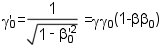
The total linear density of charge in the wire in the test charge frame

A radial electric field of infinite line charge

Force on test charge
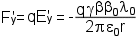
For the observer in the test charge frame wire is length contracted
Return to the lab frame
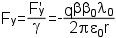
The total current I in the wire
- λ0v0 or - λ0β0c
Force on test charge


Current-Carrying Wire, positive ions and electrons are shown separated for clarity
Interaction between a current-carrying wire and charge moving at right angle to the wire.
Edward M. Purcell Electricity and Magnetism, Berkeley Physics Course, Vol. 2 in SI units


Charge moving perpendicular to the wire experiences a force parallel to the wire, perpendicular to its direction of motion. Positive ions cannot cause a horizontal field at the test charge position. The x' component of the field from
an ion on the left is exactly cancelled by the x' component of the field of a symmetrically positioned ion on the right. The effect we can see is caused by the electrons. Electrons are all moving diagonally in the test charge frame,
downward and toward the right. Consider the two symmetrically located electrons e1 and e2. Their electric fields, relativistically compressed in the direction of the electrons' motion, are represented by a field
lines. You can see that, although e1 and e2 are equally far away from the test charge, the field of electron e2 is stronger than the field of electron e1 at that location. That is
because the line from e2 to the test charge is more nearly perpendicular to the direction of motion of e2. In other words, the angle θ' that appears in the denominator of equation for the magnitude of the
field of electron in the frame moving relative to the electron is here different for e1 and e2, so that sin2θ'2 > sin2θ'1. That is true for
any symmetrically located pair of electrons on the line, as you can verify with the aid of picture. The electron on the right always acts stronger. Therefore, summing over all the electrons must give a resultant field E' in the
x direction. The y' component of the electrons' field is exactly cancelled by the field of the ions. That E'y is zero is guaranteed by Gauss's law, for the number of charges per unit length of wire is
the same as it was in the lab frame. The wire is uncharged in both frames. The force on the test charge, qE'x, transformed back into the lab frame is a force proportional to v in the x direction, which is
the direction of v×B if B is a vector in the z direction, pointing out of the page.

relativistic, electromagnetism, magnetic, field, electromagnetic, induction, physics, science,
2nd or 3rd revised edition - 1st edition was around 2016-2017
Static magnetic field
Relativistic electromagnetism
Patrick Kawecki
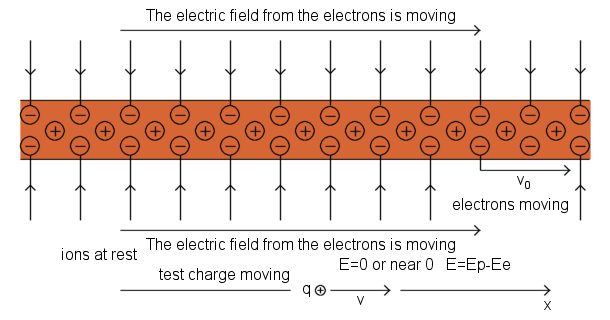
Current-Carrying Wire, positive ions and electrons are shown separated for clarity
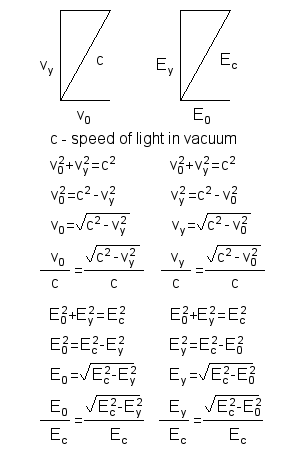
Electric field lines move together with the electrons and remain perpendicular to the conductor, but because they move sideways, the electric interaction propagates at a slight angle, thus creating a component of the electric field parallel to the conductor - this parallel component, just like the electric field of charges, decreases with increasing distance from the conductor, and this component parallel to the conductor is our magnetic field.
alternative, theory, electromagnetism, electromagnetic theory, magnetic theory, electricity, electric, explained, magnetism, origin, source, basics, physics, science,
